

A significant part of Iran’s great civilization can undoubtedly be attributed to the fundamental and strategic role of agriculture. The origin and foundation of transformation in today’s advanced societies and the development of many countries are also deeply rooted in agriculture. The most essential and fundamental input for agricultural production is high-quality seed. The genetic potential embedded in seeds strongly influences all subsequent farming activities, including planting, crop management, and final harvest. Improved seed serves as a key tool for transferring modern production technologies and plays a fundamental role in achieving food security and ensuring sustainable crop production, particularly in critical regions and under unfavorable production conditions. Therefore, it is regarded as an effective technology for the rapid improvement of sustainable agriculture. Addressing seed-related problems is, in effect, equivalent to solving a major portion of the challenges facing the agricultural sector.
Unfortunately, climate change and the excessive exploitation of natural resources over recent decades have led to a severe decline in water resources and increased soil salinity, consequently intensifying environmental stresses such as drought, salinity, heat, flooding, and others. These changes have negatively affected agricultural production trends, to the extent that current cultivars will no longer be suitable for future conditions. Hence, it is necessary to develop specific cultivars tailored to specific climate change scenarios. In recent years, breeding efforts have largely focused on high-yielding cultivars adapted to relatively normal environments, while cultivars capable of thriving under severe stress conditions remain very limited. This historical emphasis on high-yield cultivars under optimal conditions has resulted in a significant reduction in genetic diversity and the emergence of a genetic bottleneck. One effective strategy to overcome this bottleneck and enrich the genetic resources of strategic crops is to return to and focus on wild gene pools. Wild relatives are rich sources of genes conferring tolerance to both biotic and abiotic stresses, and Iran is a center of origin for many of these species. Over the past decade, genetic materials and a general framework for improving strategic crops have been established at Isfahan University of Technology, where genetic and biotechnological studies are ongoing in the Seed Engineering Group.
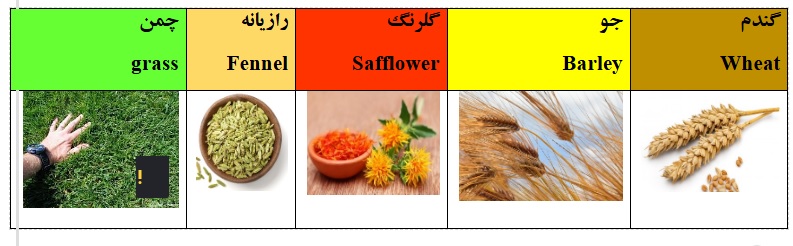
Synthetic hexaploid wheats represent a promising avenue toward a second Green Revolution. These genotypes are artificially created through crosses between tetraploid durum or emmer wheat and their diploid progenitor, Aegilops tauschii. Due to the introgression of genetic material from diploid and tetraploid wheats, synthetic hexaploid wheats possess a broader genetic base. In this study, approximately 200 synthetic lines were developed and genotyped using genotyping-by-sequencing (GBS) technology. These lines are expected to harbor valuable traits for improving yield and tolerance to biotic and abiotic stresses, including drought and salinity tolerance, early maturity, and resistance to pests and diseases, all of which are evaluated in this research.
Barley is a multipurpose crop widely used in animal feed, food industries (such as bulgur and tarhana), and the beverage industry (malt production). Due to its low water requirement, barley is considered one of the most suitable crops for cultivation under Iran’s climatic conditions. However, climate change over the past two decades has intensified environmental stresses, including drought, salinity, and heat, thereby affecting barley production and increasing the need for imports. The emphasis on high-yielding barley cultivars has significantly reduced genetic diversity, particularly for tolerance to increasing abiotic stresses, leading to a genetic bottleneck. One strategy to overcome this limitation is to utilize wild gene pools and close relatives. Wild barley (Hordeum vulgare ssp. spontaneum), a subspecies closely related to cultivated barley, is rich in genes conferring tolerance to various stresses, and some reports suggest superior grain and malting quality compared to cultivated barley. In this study, selection is conducted on 450 recombinant inbred lines derived from crosses between 21 diverse wild barley genotypes (collected from different regions worldwide) and cultivated barley (cv. Reyhan 03). Each wild genotype contributes specific chromosomal segments and genes to the cultivated background, enabling the evaluation of the effects of wild barley genomic regions on agronomic traits and offering prospects for developing stress-tolerant barley cultivars with improved productivity.
Safflower is one of Iran’s most important native crops, with applications in oil production, medicine, and forage. Given the increasing impacts of global warming and recurring droughts, enhancing drought tolerance in safflower has become essential. One effective breeding strategy is the introgression of stress-tolerance genes, particularly drought tolerance, from wild species into cultivated safflower. Wild relatives exhibit high adaptability to environmental stresses such as drought. Although Iran encompasses a vast dry region that serves as a center of diversity, evolution, and domestication for safflower, and hosts a wide distribution of wild safflower species, Iranian wild safflower germplasm has been underutilized in drought-tolerance research. Additionally, autumn sowing, which requires less irrigation due to the utilization of winter precipitation and lower temperatures, can help mitigate water scarcity. Exploiting the potential of wild species through interspecific hybridization to develop drought-tolerant and cold-adapted lines has led to notable successes in plant breeding; however, this approach has not been adequately applied in safflower. Advancing lines to recombinant inbred generations can further facilitate genetic and breeding studies. This project aims to address key breeding challenges in safflower by focusing on three germplasms derived from interspecific crosses among two wild species and one cultivated species. The interspecific crosses include (TP) Carthamus tinctorius × C. palaestinus, (TO) C. tinctorius × C. oxyacanthus, and (PO) C. palaestinus × C. oxyacanthus, with progenies advanced to later generations. Screening these genotypes for tolerance to drought, salinity, and cold enables the identification of superior drought-tolerant lines and novel genetic combinations.
Fennel is an important medicinal plant containing diverse essential oil compounds widely used in the treatment of gastrointestinal disorders, kidney stones, gynecological diseases, and other ailments. Fennel comprises four subspecies: (1) Foeniculum vulgare ssp. piperitum, (2) F. vulgare var. vulgare (bitter fennel, the only type found in Iran), (3) F. vulgare var. dulce (sweet fennel), and (4) F. vulgare var. azoricum (Florence fennel). In this research, the stability and adaptability of fennel germplasm consisting of Iranian and foreign ecotypes are evaluated. Genetic diversity related to morphological traits, survival, longevity, and recovery after prolonged irrigation cessation (at least six months) is also assessed. Additionally, polycrosses are conducted to evaluate general combining ability and to develop new hybrid varieties adapted to drought stress.
Grasses (turfgrasses) are a fundamental component of green spaces and have long held a special place in Iranian culture alongside flowers and trees, serving environmental, recreational, athletic, and ornamental purposes. One of the major challenges in urban green spaces is the widespread use of imported turfgrass cultivars with extremely high water requirements. Seed importation leads to significant foreign currency expenditure and contradicts national economic resilience policies. Moreover, imported cultivars are adapted to humid, high-water environments of their regions of origin, primarily Europe, and their maintenance in arid and semi-arid regions requires excessive water use, resulting in substantial water loss. In many cities, a large proportion of urban water consumption is allocated to green spaces, with reported water usage reaching up to 12 mm per day—exceeding annual natural precipitation levels. These turfgrasses also possess shallow root systems and exhibit low drought tolerance, making their use under drought conditions unsustainable. Typically, these grasses require daily or multiple weekly irrigation during warm seasons, consuming an average of 15 liters of water per square meter per irrigation event.
Over the past 15 years, extensive collaboration with international gene and seed banks has enabled the collection of more than 300 turfgrass accessions from around the world. These resources are utilized to breed turfgrasses adapted to Iran’s arid and semi-arid conditions while enabling comparative studies and genomic integration of global turfgrass diversity. Breeding objectives extend beyond green spaces to include soil erosion control, flood prevention, and forage use in rangelands. Key goals include identifying and genetically improving drought-tolerant turfgrasses by exploiting native genetic diversity with strong root systems and stress-resistance genes, combining them with foreign germplasm to improve turf quality, enhancing salinity tolerance through targeted hybridization, and improving traits related to survival, persistence, post-drought recovery, and summer and winter dormancy. Ultimately, the development of stress-adapted cultivars and the production of a national turfgrass seed represent major outcomes of this project.